my new toy..
- abeadle
- Mar 29
- 2 min read
Updated: Apr 21
I’m loving my new toy 'The Feet Up'
bought to me by the most beautiful Catherine Zinger
.

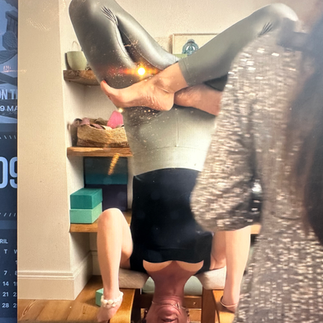


It can be used for so many postures as support and lift.
In Sirsasana my neck feels completely free
.
Stil,l I’m working, as I push my shoulders down and I stretch my legs up
.
In just in case you didn’t know, this wonderful prop is an adaptation of BKS Iyengar’s original use of 2 chairs for Sirsasana
.
But this is better, it’s fabulous-
it’s padded, easy to move around and you can use it for so many other exercises too.
.
Absolutely loving it 😊
B.K.S. Iyengar called Sirsasana 'the king of asanas.'
Because of the combination of physical, physiological, mental and symbolic effects Sirsasana (headstand) has.
Iyengar regarded it as a supreme, organizing posture.
here are the reasons:
Circulation and drainage
An inversion shifts more blood toward the head and upper torso, improving venous return and drainage from the legs.
Nervous-system and endocrine effects
Inversions tend to alter autonomic tone (often increasing parasympathetic activity after the effort), which many people experience as calmness and reduced stress. Classical yoga and Iyengar both describe beneficial effects on the pituitary and other glands.
Strength, alignment and posture
Sirsasana demands shoulder, arm and core strength and precise alignment of the spine and neck. Practicing it builds the muscular control and postural awareness that transfer to many other asanas and everyday posture.
Mental focus and confidence
Because it’s technically demanding and requires concentration and steadiness, headstand develops mental focus, balance of mind and confidence.
In many systems it’s considered a “master” pose that integrates breath, body and attention.
Therapeutic and organizing role
Iyengar emphasized therapeutic effects of poses done with correct alignment. He used Sirsasana as a restorative and balancing posture for various conditions when taught correctly. As a central inversion it often sits near the apex of a sequence, helping organize the practice.
Symbolic reasons
“King of asanas” also reflects the pose’s status: it crowns a practice, is visually striking and traditionally marks a level of technical maturity.
Happy practising.
Remember, practise and all is coming
Sending love and peace xxxx


Comments